
Epicurus: Don’t Worry about Death, It Won’t Even Last a Millisecond
Ancient Greek philosopher Epicurus argues death is absolutely nothing to fear, “because as long as we exist, death is not here. And once it does come, we no longer exist.”


Still Life with a Skull, by Philippe de Champaigne (1671), via Wikimedia Commons
Ancient Greek philosopher Epicurus advocated an atomic, naturalistic view of the universe. He rejected the existence of an immaterial soul, or of anything non-physical, and said that the gods have no influence on our lives. Accordingly, he believed being dead is not to be feared, for none of us will ever experience it.
As he puts it in a famous aphorism (from Diogenes Laertius’s celebrated survey of ancient Greek thinkers, Lives of the Eminent Philosophers, compiled in the third century CE, and also featured in Epicurus’s Principal Doctrines):
Death does not concern us, because as long as we exist, death is not here. And once it does come, we no longer exist.
From this doctrine arose the popular epitaph, engraved on tombs throughout the Roman Empire: Non fui, fui, non sum, non curo (I was not; I was; I am not; I do not care).
No consciousness means no time
To fully grasp Epicurus’s point, consider what happens when we’re unconscious. We do not experience unconsciousness. In dreamless sleep, for instance, we wake in the morning, and our most recent memory is the last thing we did at night. Though hours may have passed, we did not experience their passing: we just jumped to the next conscious episode.
So, though on the naturalistic view death is often characterized as an eternal abyss, a black silence, a terrifying nothingness, this characterization is misleading, for it suggests we’ll experience this eternal blackness.
But death means the experiencing subject no longer exists. There will be no consciousness there to experience silence, darkness, or the passing of time.
The reason we struggle to imagine what this state is like is because there is nothing it is like to be in it. Consciousness is all we’ve ever known, and all we ever can know.
We learn objectively that the universe existed before we were born, and that it will continue after our deaths; but from our subjective perspectives all that’s ever existed is our consciousness. The non-existence of consciousness thus feels like an outrageous impossibility.
We struggle to comprehend our lives as a finite block of time because we live only inside the block. We characterize anything outside the block as eternal blackness or oblivion, because that’s a tempting conception of ‘nothingness’.
But, by contemplating unconsciousness and dreamless sleep, we can recognize that nothingness isn’t like that.
As the Roman philosopher Lucretius also advises in his beautiful reflection on mortality, just like before we were born, in death we won’t experience anything that happens – no pleasure, no pain, no anxiety, no fear – for the conscious self simply isn’t there:
we felt no distress when the Carthaginians were attacking Rome on every side; and the whole world was shaken by the frightening tumult of that war… and in the same way in the future, when we shall no longer exist, and the final breaking up occurs for the body and spirit from which we are now compounded into a single unit, nothing whatever will be able to happen to us, or produce any sensation – not even if the the earth should collapse in to the sea, or the sea explode in the sky…
As the philosopher Tom Clark observes with his intriguing notion of generic subjective continuity, if after death our consciousness was to be magically resurrected millions of years in the future, we’d have no sense of the time that had passed. Our last conscious experience would have seemed but a moment ago.
So, Epicurus concludes, don’t worry about being dead: it won’t even last a millisecond.
What do you make of Epicurus’s analysis?
- Do you think Epicurus is right in declaring death is nothing to fear?
- Or is the prospect of non-consciousness, of being deprived of experience and time, rightly feared? (In his beautifully haunting poem, Aubade, for example, Philip Larkin calls out “specious stuff that says No rational being / Can fear a thing it will not feel, not seeing / That this is what we fear…”)
To inform your answers, you might enjoy the following related Philosophy Breaks:
- Why Death is Nothing to Fear: Lucretius and Epicureanism
- Heidegger: We Are Time Unfolding (and our Time is Finite)
- Seneca On Coping with the Shortness of Life
- Jorge Luis Borges: When We Die, What Dies With Us?
- Pantheism: Spinoza and the God that Einstein Believed In
- Epicureanism Defined: Philosophy is a Form of Therapy
- Epicureanism: the Best 6 Books to Read
Get one famous philosophical idea in your inbox each Sunday
If you enjoyed this article, you might like my free Sunday breakdown. I distill one piece of wisdom from philosophy each week; you get the summary delivered straight to your email inbox, and are invited to share your view. Consider joining 27,000+ subscribers and signing up below:
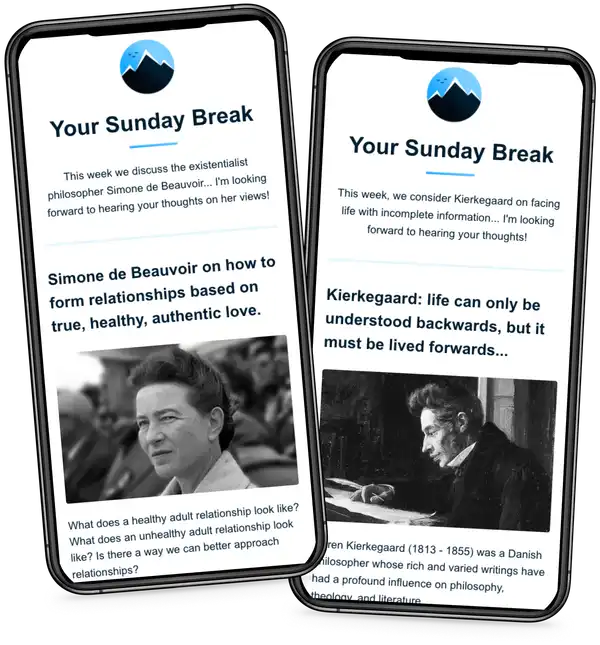
From the Buddha to Nietzsche: join 27,000+ subscribers enjoying my free Sunday Breakdown
In one concise email each Sunday, I break down a famous idea from philosophy. You get the distillation straight to your inbox.
💭 One short philosophical email each Sunday. Unsubscribe any time.
About the Author


Jack MadenFounder
Philosophy Break
👋 My name’s Jack, and I’m the Founder and Director of Philosophy Break. I’m the author of The Philosophy Prescription, which is due for publication by Torva (Penguin Random House) in September 2026. Learn more about me and Philosophy Break here.
If you enjoy learning about humanity’s greatest thinkers, you might like my free Sunday email. I break down one mind-opening idea from philosophy, and invite you to share your view.
Subscribe for free here, and join 27,000+ philosophers enjoying a nugget of profundity each week (free forever, no spam, unsubscribe any time).


Take Another Break
Each break takes only a few minutes to read, and is crafted to expand your mind and spark your philosophical curiosity.


Get one mind-opening philosophical idea distilled to your inbox every Sunday (free)


From the Buddha to Nietzsche: join 27,000+ subscribers enjoying a nugget of profundity from the great philosophers every Sunday:
★★★★★ (100+ reviews for Philosophy Break). Unsubscribe any time.
